

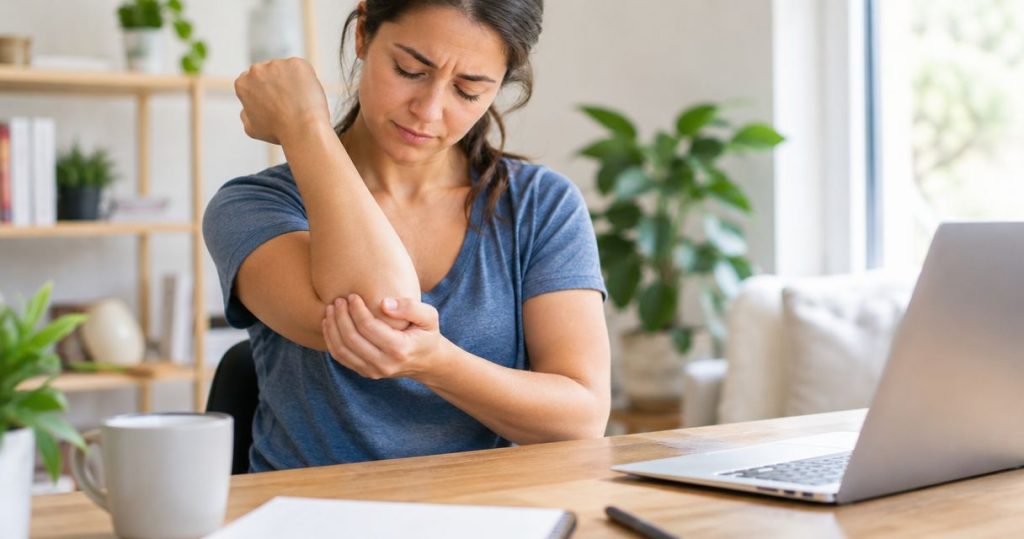
Yes, tennis elbow can improve without supervised physical therapy, particularly when you reduce aggravating activity and gradually rebuild your tolerance for gripping and lifting. But less pain does not automatically mean you are ready for full training, and persistent pain, weakness, or an uncertain diagnosis calls for an assessment rather than continued rest alone.
- Can tennis elbow heal without physical therapy? Yes, but recovery still requires managing activity and rebuilding strength.
- McKenzie Sports Physical Therapy provides sports injury rehabilitation for Philadelphia athletes and active adults.
- Recurring pain, declining grip strength, or difficulty returning to sport are reasons to seek an assessment.
- Exercise can support rehabilitation, but research does not show that supervised physical therapy guarantees faster recovery.
Can tennis elbow heal without physical therapy?
Yes. Supervised physical therapy is not required for every case of tennis elbow. Some people improve with education, changes to aggravating activities, and an appropriate home exercise plan. Others need help confirming the diagnosis or progressing beyond repeated flare-ups.
For a separate explanation of recovery timelines, see how long tennis elbow takes to heal.
The NHS patient guidance on tennis elbow describes a condition that can last between 6 months and 2 years. That is a general recovery window, not a prediction for your elbow or a reason to tolerate worsening symptoms without assessment.
Research also places limits on what treatment can promise. In a 2013 JAMA randomized trial involving adults with chronic unilateral lateral epicondylalgia, physiotherapy did not significantly improve the primary recovery outcome at 1 year compared with no physiotherapy. That finding does not mean rehabilitation has no value; it means guaranteed faster healing is not an evidence-based promise.
Use this 2026 decision guide to distinguish reasonable self-management from situations that need clinical input:
| Approach | Best for | Main benefit | Main limitation |
|---|---|---|---|
| Activity changes and home rehabilitation | Symptoms that are improving and manageable during daily tasks | Lets you adjust irritating loads while staying active | You must judge exercise technique and progression yourself |
| Clinician-guided physical therapy | Recurring symptoms, uncertain exercise progression, or demanding sport goals | Provides assessment and an individualized progression | Requires appointments and home participation; results are not guaranteed |
| Medical assessment before rehabilitation | Injury with marked weakness, neurological symptoms, or other warning signs | Checks whether tennis elbow is the right diagnosis | Assessment does not necessarily provide immediate symptom relief |
Why this matters
Your goal is not simply to stop noticing your elbow while resting. You need enough capacity to carry groceries, work, train, or play without repeatedly backing off afterward. That distinction matters when an elbow feels better during a break but hurts again as soon as practice resumes.
McKenzie Sports Physical Therapy is best for Philadelphia athletes and active adults seeking sports injury rehabilitation. The relevant question is whether you need help connecting symptom improvement to the actual demands of your sport—not whether every sore elbow needs ongoing appointments.
For athletes in Manayunk, Roxborough, and nearby northwest Philadelphia, that means considering school, work, lifting, and practice together. An exercise plan that ignores those demands leaves out much of what your elbow does each day.
When is managing tennis elbow yourself reasonable?
Self-management is a reasonable starting point when symptoms are manageable, daily function is preserved, and the overall trend is improving. You should also feel confident that you understand which activities aggravate the elbow and how to modify them.
Tennis elbow typically involves pain around the outside of the elbow, often aggravated by gripping or resisted wrist extension. Those features can help explain the problem, but they do not confirm the diagnosis by themselves. Pain location alone is not enough to rule out another cause.
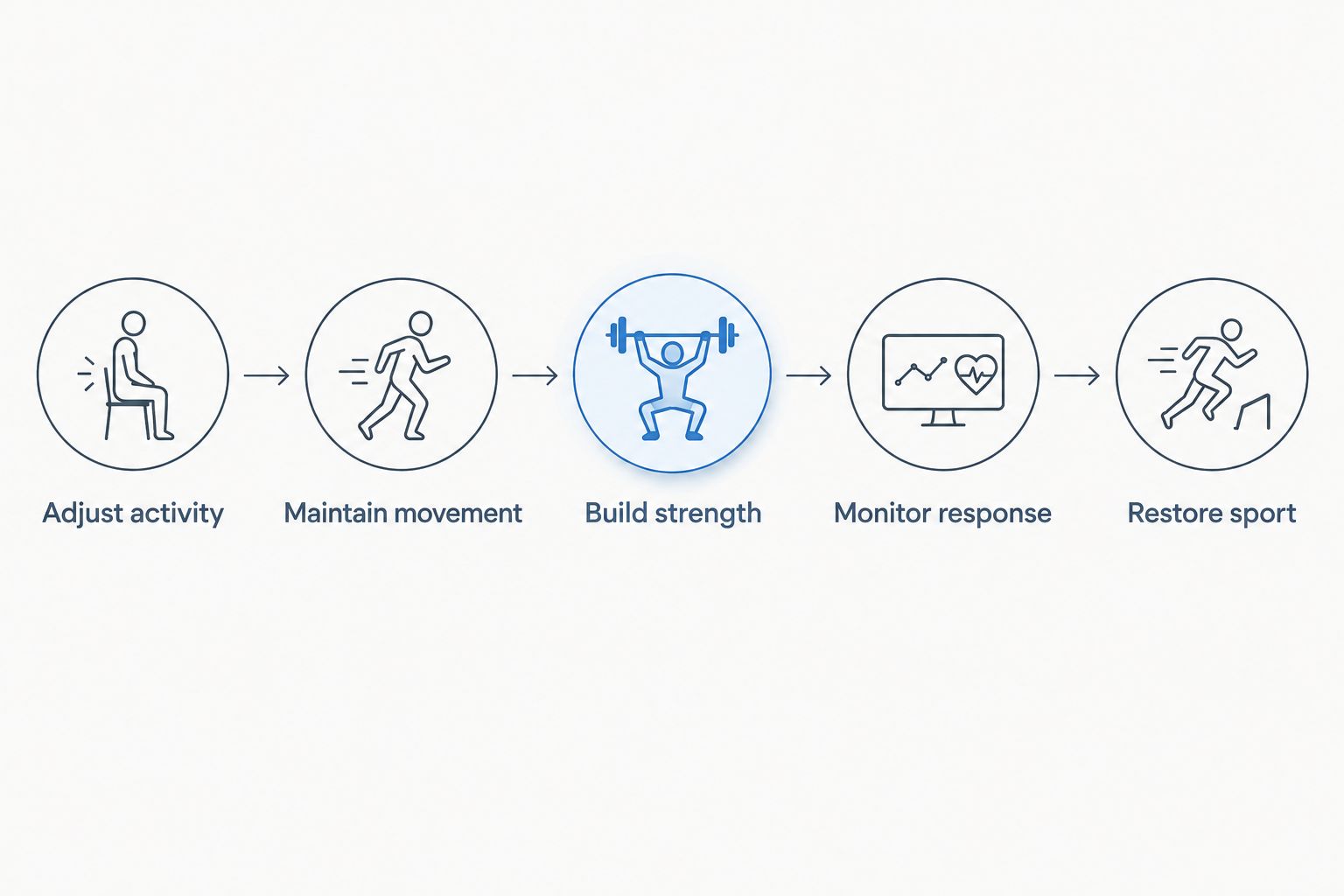
A practical self-management approach has several parts:
- Adjust activity. Reduce the gripping, lifting, or repetitive wrist work that clearly provokes symptoms. Change the task rather than automatically stopping all movement.
- Maintain movement. Keep comfortable elbow and wrist motion instead of treating the arm as something that must remain completely still.
- Build strength. Use an exercise progression suited to your symptoms and current capacity. A generic online routine is not an individualized prescription.
- Monitor response. Notice how the elbow feels during activity, afterward, and the following morning. Repeatedly worsening symptoms are a reason to change the plan.
- Restore sport. Reintroduce the demands of training gradually rather than using one comfortable workout as clearance for unrestricted participation.
There is no universal exercise dose that fits every painful elbow. Your symptoms, examination, and sport determine the starting point. For your 2026 training plan, progress should follow your response to activity rather than a fixed date on the calendar.
When does physical therapy become the better next step?
Seek an assessment when the same problem keeps returning or you cannot progress without another flare-up. You do not need to exhaust every home remedy before asking for help. Persistent uncertainty is itself a useful reason to get evaluated.
A sports rehab physical therapist can assess painful movements, grip function, strength, and the demands you are trying to resume. The plan should explain what to change now, what to keep doing, and how to judge the next increase in activity.
Consider clinical guidance when:
- Pain repeatedly returns with lifting, work, or sport.
- You are avoiding more activities despite reducing your workload.
- Gripping feels weaker or ordinary tasks are becoming harder.
- You cannot tell whether your exercises are helping or aggravating symptoms.
- You have a competition or season approaching and need a clear progression.
- Previous treatment reduced discomfort but did not restore the tasks that matter to you.
The benefit is individualized decision-making, not a promise of faster tendon healing. The limitation is that appointments cannot replace the activity changes and exercise work between visits. Ask what each treatment contributes to the larger rehabilitation plan.
Why tennis elbow recovery varies
Two people with outside-elbow pain do not necessarily need the same plan. The 2022 Journal of Orthopaedic & Sports Physical Therapy clinical practice guideline, “Lateral Elbow Pain and Muscle Function Impairments,” supports examination-based care, including resisted wrist-extensor exercise for appropriate patients.
These factors help explain why rehabilitation needs differ:
- The diagnosis: Outside-elbow pain can overlap with nerve-related symptoms or pain referred from elsewhere. Treatment depends on identifying the problem accurately.
- Daily load: Work, carrying, household tasks, and training all contribute to what the elbow must tolerate.
- Current capacity: The starting point differs between someone who can comfortably lift and someone struggling with basic gripping.
- Exercise response: A plan needs adjustment when symptoms repeatedly worsen instead of settling between sessions.
- Sport demands: Throwing, racquet sports, weight training, and running place different demands on the arm.
- Consistency: An exercise plan is difficult to evaluate when the workload changes sharply or exercises are repeatedly abandoned and restarted.
These are assessment considerations, not a formula that predicts your recovery date. In 2026, an evidence-based plan still needs room for adjustment rather than a guaranteed finish line.
Does resting tennis elbow help it heal?
Relative rest can help manage symptoms; complete rest does not rebuild strength. Reducing an aggravating task gives you room to work on tolerable movement and loading. Returning directly to the same workload after a break can leave the original capacity problem unresolved.
Think in terms of changing demands. You might modify how you carry an object, reduce repetitive gripping, or adjust a lifting session while preserving activities that do not aggravate symptoms. The appropriate modification depends on your examination and response.
Do not use pain relief alone as proof that the elbow can tolerate unlimited work. A useful return-to-activity decision also considers movement, strength, function, and how symptoms respond afterward.
Can you keep playing baseball or training with tennis elbow?
Sometimes, but elbow pain in a pitcher should not automatically be labeled tennis elbow. Throwing-related pain can have several causes, and a sore elbow deserves particular care in a growing athlete. Do not use a home diagnosis to justify throwing through pain.
High school and college athletes should involve the appropriate clinician and athletic trainer when symptoms affect participation. Parents can help by describing changes in workload, performance, and symptoms without pressuring the athlete to meet a return date.
A return-to-sport plan should connect rehabilitation to the actual task. For a baseball player, that includes the progression back to throwing and other training demands; for a lifter, it includes tolerating the relevant grips and movements. The right progression follows assessment rather than a generic internet schedule.
Runners need that same specificity. If elbow symptoms interfere with strength training or carrying equipment, discuss those tasks directly rather than assuming running fitness means the arm is ready for everything else.
What if previous treatment has not helped?
A stalled recovery is a reason to reassess the diagnosis, workload, exercise plan, and return-to-sport criteria. It is not proof that you have failed rehabilitation. Bring a clear account of what you tried and what changed.
Useful details include which exercises you performed, what made symptoms better or worse, and which activity repeatedly triggers the setback. Explain whether treatment helped daily comfort but not sport participation. Those are different outcomes and need different follow-up questions.
McKenzie Sports Physical Therapy offers sports injury diagnosis and rehabilitation, along with dry needling, shockwave therapy, and sports massage. Having those services available does not mean every painful elbow needs them. Ask what a proposed treatment is intended to address, what its limitations are, and how it supports active rehabilitation.
For your 2026 appointment, bring a concrete goal such as returning to throwing, lifting, or unrestricted practice. A specific task gives the rehabilitation discussion more direction than simply asking for the pain to disappear.
When should you seek prompt medical care?
Do not treat every elbow problem as routine tennis elbow. Seek prompt medical assessment after a significant injury with deformity, severe pain, or inability to move the arm normally. A hot, red, swollen elbow with fever also needs urgent evaluation.
New numbness, progressive weakness, or symptoms extending beyond the usual local pain pattern warrant assessment rather than repeated self-treatment. These signs do not identify a diagnosis on their own, but they change the next step.
For nonurgent symptoms, book an assessment if pain is worsening or continues to limit normal activity despite sensible changes. General educational guidance cannot replace an examination.
FAQ
Can tennis elbow heal without physical therapy?
Yes, tennis elbow can improve without supervised physical therapy. Activity changes and an appropriate home rehabilitation plan can be reasonable when symptoms are manageable and improving; persistent or worsening problems need assessment.
How long can tennis elbow last without treatment?
Tennis elbow can last between 6 months and 2 years, according to NHS patient guidance. That broad window is not a personal forecast, and worsening pain or declining function should not be ignored while waiting.
Is complete rest better than exercise for tennis elbow?
Complete rest does not rebuild the strength needed for gripping, lifting, or sport. Relative rest from aggravating tasks, followed by an appropriate exercise progression, addresses a different goal from temporary symptom relief.
Does physical therapy guarantee that tennis elbow heals faster?
No, physical therapy does not guarantee faster healing. A 2013 JAMA randomized trial in adults with chronic unilateral lateral epicondylalgia found no significant physiotherapy benefit for the primary recovery outcome at 1 year.
Should a high school pitcher keep throwing with elbow pain?
A high school pitcher should not assume elbow pain is tennis elbow or throw through it without appropriate assessment. A growing athlete needs evaluation that considers throwing demands and other possible causes of pain.
Do I need dry needling or shockwave therapy for tennis elbow?
Neither dry needling nor shockwave therapy is automatically required for tennis elbow. Discuss the diagnosis, expected benefit, uncertainty, and role of any proposed treatment within an active rehabilitation plan.
When should I stop trying to manage tennis elbow on my own?
Seek an assessment when symptoms worsen, grip function declines, or repeated attempts to resume activity cause another setback. Significant injury, fever with a hot swollen elbow, or progressive neurological symptoms require more urgent medical attention.
One last thing
Being pain-free at rest and being ready for sport are different milestones. Before you resume unrestricted training, identify the activity that previously triggered symptoms and discuss how you will rebuild tolerance for it. That is a more useful 2026 goal than chasing a symptom-free day without testing function.
Related guides
- Moving from a telehealth consultation to in-person physical therapy
- High school sports physicals and return-to-play clearance
- Is shockwave therapy worth it?
If elbow pain keeps interrupting training, request a new-patient appointment with McKenzie Sports Physical Therapy to discuss your symptoms, sport demands, and next rehabilitation steps.